
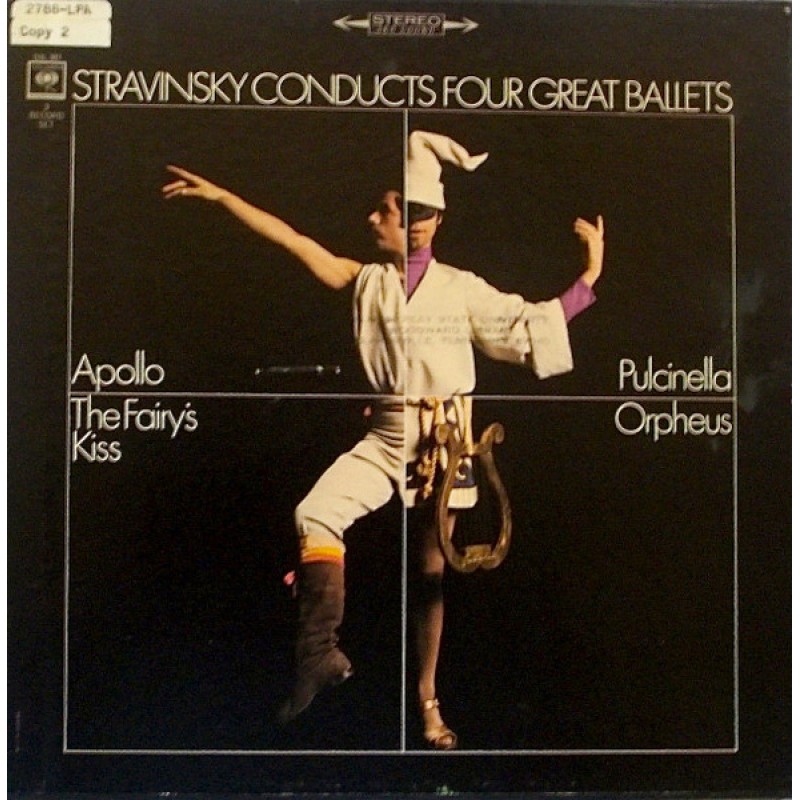
Igor Stravinsky – Stravinsky Conducts Four Great Ballets (Apollo; Orpheus; Pulcinella; The Fairys Kiss)
- Artist: Igor Stravinsky
- Cod produs: D3S 761
- Disponibilitate: In Stoc
0,00lei
- Fără TVA: 0,00lei
Livrare gratuită pentru cumpărături de peste 400 lei
Artist: Igor Stravinsky
Label: Columbia Masterworks
Format: Vinyl - LP, Stereo
Country: US
Year: 1967
Genres: Classical
Styles: Modern, Ballet
Collection Media Condition: Near Mint (NM or M-)
Collection Sleeve Condition: Very Good Plus (VG+)
Notes: 2-eye "360 SOUND" label
Tracklist:
Orpheus (Ballet In Three Scenes)
Apollo (Apollon Musagète) (Ballet In Two Scenes)
The Fairy's Kiss (Le Baiser De La Fée) (Complete Ballet)
Pulcinella (Revised Version) (Ballet With Song In One Act After Pergolesi) (Complete)
Artist: Igor Stravinsky
Born: 1882-06-17 (Oranienbaum, Saint Petersburg Governorate, Russian Empire) At present Lomonosov, Russian Federation.
Died: 1971-04-06 (New York City, New York, United States).
Russian composer, pianist and conductor.
Main figure of musical modernism, one of the greatest representatives of world musical culture of the 20th century.
The composer's creative itinerary was extremely dynamic.
Stravinsky's musical language tends to overcome the barrier of historical periods and uses historical and personal models
(such as Russian folklore, Western cultured tradition, dodecaphony, polyrhythms and asymmetrical rhythms)
freely adapting them to his personal creative needs.
In stravinsky's works the rhythmic dimension is extremely dynamic and varied and becomes a structural element of the composition, as is the interval elaboration.
The composer uses melodic cells that are reassembled and broken down with great variety and freedom, the overlapping and reiteration of rhythmic-interval cells creates episodes of rhythmic-metric asymmetry and polyrhythm.
Other elements that we find in his compositions are: the structuring in discordant sections, the use of the octotonic scale and the modal scales.
He has written music for a variety of different instrumental and vocal combinations, ranging from works for huge orchestras to works for small ensembles or solo instruments
Starting from the 1950s he wanted to leave a precise sound testimony of his creative intentions, through the recording of his works directed by himself
A citizen of France (1934) and the USA (1945).
Died: 1971-04-06 (New York City, New York, United States).
Russian composer, pianist and conductor.
Main figure of musical modernism, one of the greatest representatives of world musical culture of the 20th century.
The composer's creative itinerary was extremely dynamic.
Stravinsky's musical language tends to overcome the barrier of historical periods and uses historical and personal models
(such as Russian folklore, Western cultured tradition, dodecaphony, polyrhythms and asymmetrical rhythms)
freely adapting them to his personal creative needs.
In stravinsky's works the rhythmic dimension is extremely dynamic and varied and becomes a structural element of the composition, as is the interval elaboration.
The composer uses melodic cells that are reassembled and broken down with great variety and freedom, the overlapping and reiteration of rhythmic-interval cells creates episodes of rhythmic-metric asymmetry and polyrhythm.
Other elements that we find in his compositions are: the structuring in discordant sections, the use of the octotonic scale and the modal scales.
He has written music for a variety of different instrumental and vocal combinations, ranging from works for huge orchestras to works for small ensembles or solo instruments
Starting from the 1950s he wanted to leave a precise sound testimony of his creative intentions, through the recording of his works directed by himself
A citizen of France (1934) and the USA (1945).