
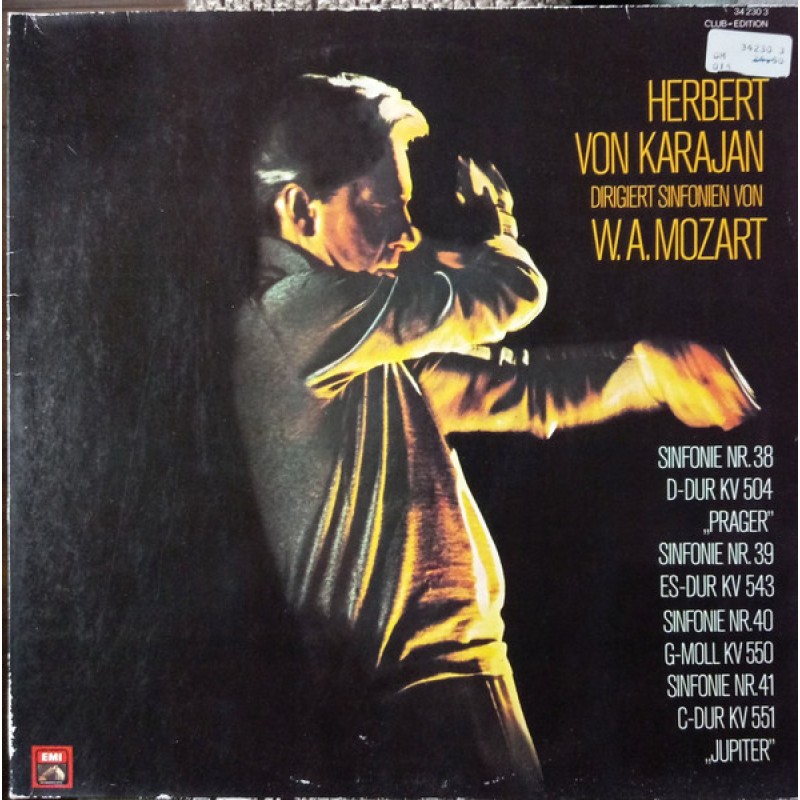
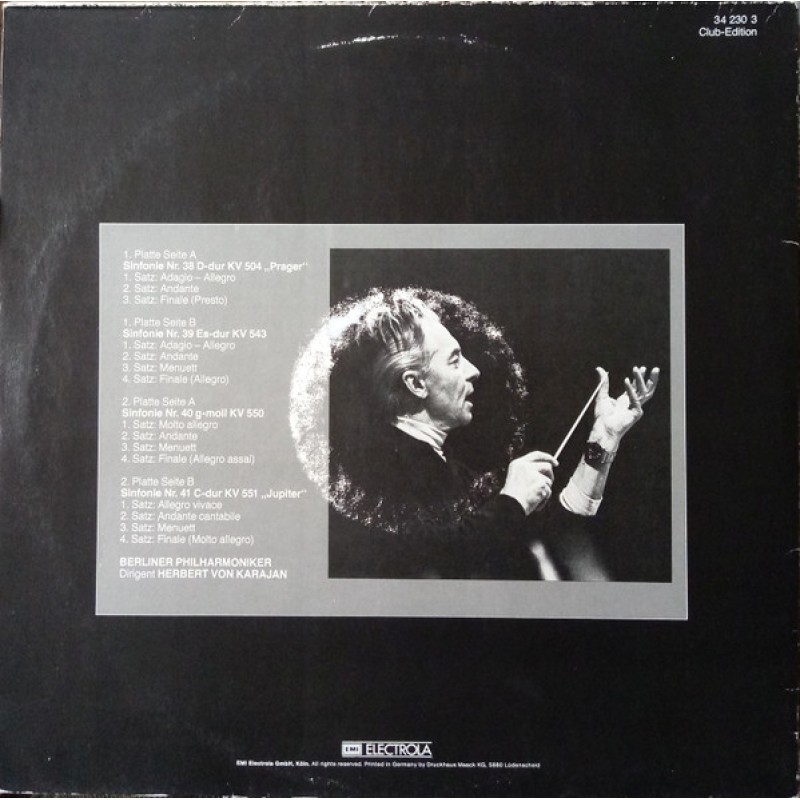
Herbert von Karajan, Wolfgang Amadeus Mozart – Herbert Von Karajan Dirigiert Sinfonien Von W.A. Mozart
- Artist: Herbert von Karajan, Wolfgang Amadeus Mozart
- Cod produs: 34 230 3
- Disponibilitate: In Stoc
0,00lei
- Fără TVA: 0,00lei
Livrare gratuită pentru cumpărături de peste 400 lei
Artist: Herbert von Karajan, Wolfgang Amadeus Mozart
Label: His Master's Voice
Format: Vinyl - LP, Compilation, Club Edition, Stereo
Country: Germany
Year: 1983
Genres: Classical
Styles: Classical
Collection Media Condition: Near Mint (NM or M-)
Collection Sleeve Condition: Near Mint (NM or M-)
Notes: Made in Germany
Tracklist:
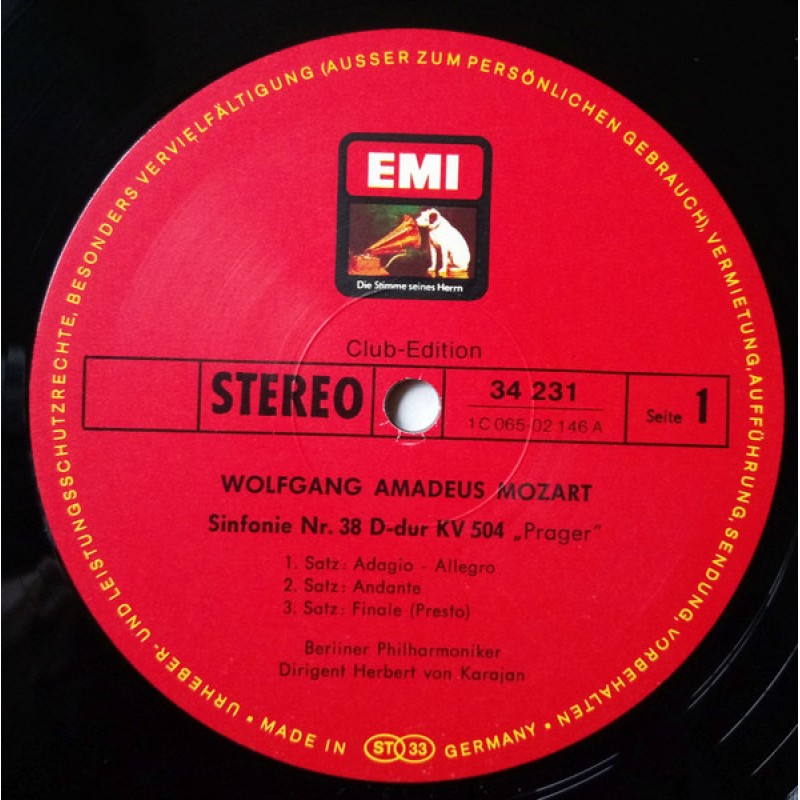
Sinfonie Nr.38 D-dur KV 504 "Prager"
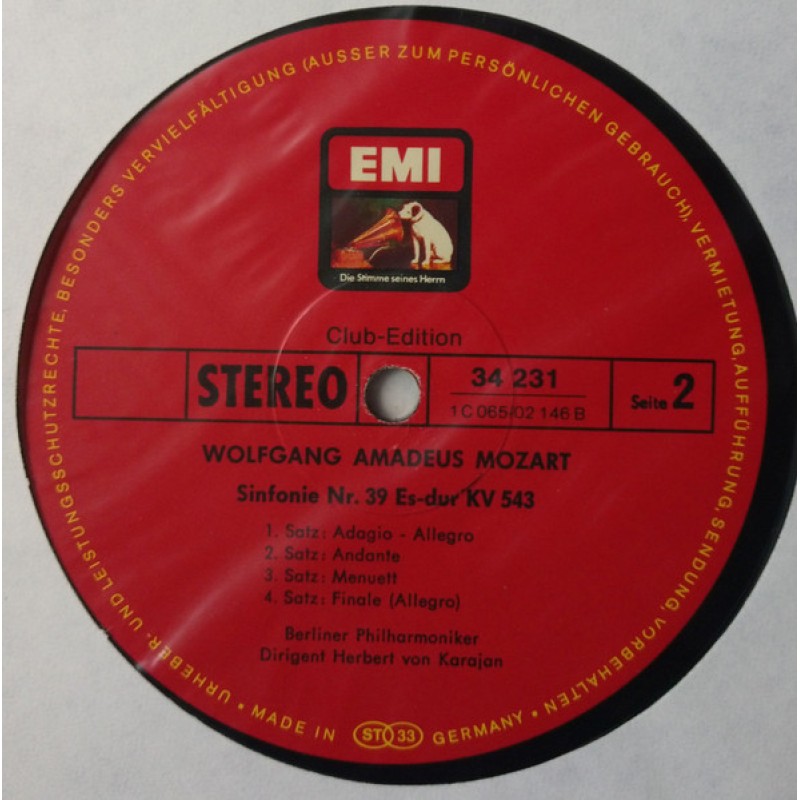
Sinfonie Nr.39 Es-dur Kv 543
Sinfonie Nr.40 G-moll KV 550
Sinfonie Nr.41 C-dur KV 551 "Jupiter"
Artist: Herbert von Karajan, Wolfgang Amadeus Mozart
Austrian conductor. He was principal conductor of the [a260744] for 34 years. He is considered one of the most famous and greatest conductors of the 20th century.
Born April 5, 1908 in Salzburg, Austria-Hungary (now Austria)
Died July 16, 1989 in Anif, Austria (aged 81)
Herbert von Karajan was born in Salzburg, Austria-Hungary (now Austria), the second son of the surgeon and consultant Ernst von Karajan (1868-1951) and Marta (1881-1954). He was a child prodigy at the piano. From 1916 to 1926, he studied piano at the Mozarteum in Salzburg with Franz Ledwinka, harmony with Franz Sauer and composition with Bernhard Paumgartner. Karajan was encouraged to study conducting by Bernhard Paumgartner, who detected his exceptional promise in that regard. In 1926, Karajan graduated from the conservatory and continued his studies at the Vienna Academy, studying piano with Josef Hofmann (not be confused with the american pianist [a1901295]) and conducting with Alexander Wunderer and Franz Schalk. Karajan made his debut as a conductor in Salzburg on 22 January 1929.
In 1933 and 1935 Herbert von Karajan joined to the Nazi Party. Karajan remained silent about his membership in the Nazi Party, leading to a number of conflicting theories about it. One version is that due to the changing political climate and the destabilization of his position, Karajan attempted to join the Nazi Party in Salzburg in April 1933, but his membership was later declared invalid because he somehow failed to follow up on the application, and that Karajan formally joined the Nazi Party in Aachen in 1935, implying that he was not eager to seek membership and that he joined the Nazi Party solely for career reasons. Other theories say that Karajan joined the Nazi Party for ideological reasons rather than for career reasons, even more than 10 years later in 1955 the music director of the [a27519], [a809856] refused to shake Karajan's hand because of his past in the Nazi Party.
In 1946, Karajan gave his first postwar concert in Vienna with the [a754974], but was banned from further conducting by the Soviet occupation authorities because of his Nazi party membership. That summer he participated anonymously in the Salzburg Festival. On 28 October 1947, Karajan gave his first public concert following the lifting of the conducting ban. With the Vienna Philharmonic and the Gesellschaft der Musikfreunde, he performed [a304975] "A German Requiem" for a gramophone production in Vienna. In 1954, he succeeded [a=Wilhelm Furtwängler] in the direction of the [a=Berliner Philharmoniker]; orchestra that has reached supreme degrees of perfectionism thanks to his tenacity and to his well-known meticulousness combined with a perfect knowledge of the orchestra and the possibilities of the instrumentalists.
Born April 5, 1908 in Salzburg, Austria-Hungary (now Austria)
Died July 16, 1989 in Anif, Austria (aged 81)
Herbert von Karajan was born in Salzburg, Austria-Hungary (now Austria), the second son of the surgeon and consultant Ernst von Karajan (1868-1951) and Marta (1881-1954). He was a child prodigy at the piano. From 1916 to 1926, he studied piano at the Mozarteum in Salzburg with Franz Ledwinka, harmony with Franz Sauer and composition with Bernhard Paumgartner. Karajan was encouraged to study conducting by Bernhard Paumgartner, who detected his exceptional promise in that regard. In 1926, Karajan graduated from the conservatory and continued his studies at the Vienna Academy, studying piano with Josef Hofmann (not be confused with the american pianist [a1901295]) and conducting with Alexander Wunderer and Franz Schalk. Karajan made his debut as a conductor in Salzburg on 22 January 1929.
In 1933 and 1935 Herbert von Karajan joined to the Nazi Party. Karajan remained silent about his membership in the Nazi Party, leading to a number of conflicting theories about it. One version is that due to the changing political climate and the destabilization of his position, Karajan attempted to join the Nazi Party in Salzburg in April 1933, but his membership was later declared invalid because he somehow failed to follow up on the application, and that Karajan formally joined the Nazi Party in Aachen in 1935, implying that he was not eager to seek membership and that he joined the Nazi Party solely for career reasons. Other theories say that Karajan joined the Nazi Party for ideological reasons rather than for career reasons, even more than 10 years later in 1955 the music director of the [a27519], [a809856] refused to shake Karajan's hand because of his past in the Nazi Party.
In 1946, Karajan gave his first postwar concert in Vienna with the [a754974], but was banned from further conducting by the Soviet occupation authorities because of his Nazi party membership. That summer he participated anonymously in the Salzburg Festival. On 28 October 1947, Karajan gave his first public concert following the lifting of the conducting ban. With the Vienna Philharmonic and the Gesellschaft der Musikfreunde, he performed [a304975] "A German Requiem" for a gramophone production in Vienna. In 1954, he succeeded [a=Wilhelm Furtwängler] in the direction of the [a=Berliner Philharmoniker]; orchestra that has reached supreme degrees of perfectionism thanks to his tenacity and to his well-known meticulousness combined with a perfect knowledge of the orchestra and the possibilities of the instrumentalists.